Every item that crosses the counter gets checked before a price is set. It is not personal. Counterfeit coins and bars exist, plated jewelry can look like solid gold, and stamps are sometimes wrong. Testing protects the seller as much as the buyer, because it means the price is based on what the item actually is.
Here are the methods dealers commonly use, and what each one tells us.
Looking closely
Testing starts with the eyes. We may check stamps and hallmarks, edges, lettering, wear patterns and the overall look of a piece under magnification. A karat mark such as 10K, 14K or 18K, or a silver mark like 925, is a starting point. It is not proof on its own.
Weight and measurements
Genuine bullion coins are made to precise specifications. Comparing a coin’s weight, diameter and thickness against the known figures is a simple and powerful check. A coin that is the right size but the wrong weight is a warning sign.
The magnet test
Gold and silver are not magnetic. If a piece jumps to a strong magnet, it is not solid gold or silver. A piece that ignores the magnet is not automatically genuine, though, since some fake metals are not magnetic either. It is a quick first screen.
The ping test
Silver coins have a distinctive ring when gently tapped or balanced and struck. Many base metal fakes sound dull by comparison. It takes some experience to hear the difference, and it works best alongside other checks.
Specific gravity
Every metal has its own density. Specific gravity testing compares an item’s weight in air with its weight in water to estimate that density. Pure gold is far denser than most metals used to imitate it. This method is useful because it looks at the whole piece, not just the surface.
XRF analysis
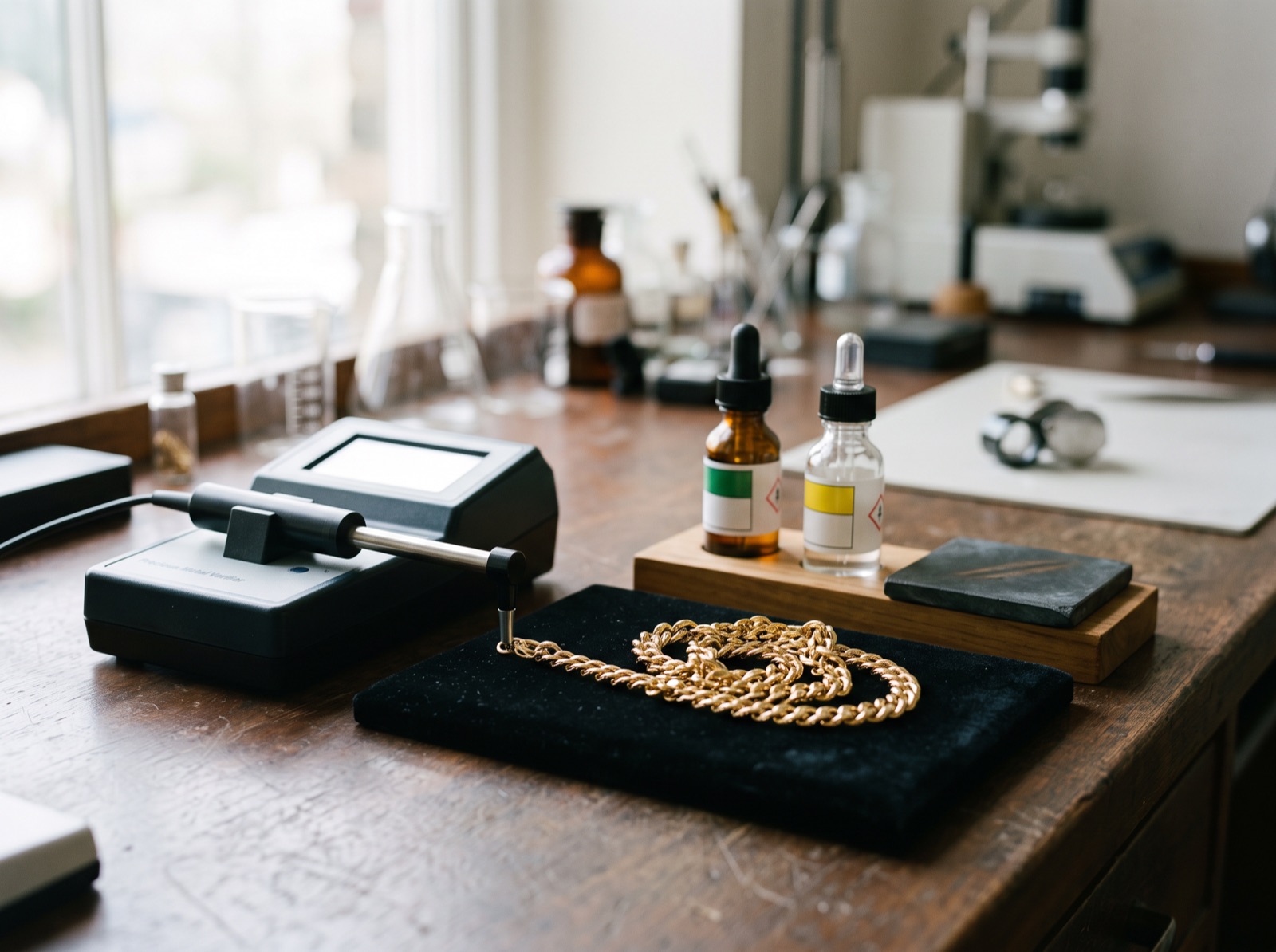
X-ray fluorescence, or XRF, reads the metals present at the surface of an item without harming it. It is fast and non-destructive. Its limit is that it reads the surface, so a thick plating can still need a second check.
Acid testing on scrap
For scrap gold and jewelry, the acid test is a long-standing method. A small streak of metal is rubbed onto a testing stone, then a drop of acid made for a particular karat is applied. How the streak reacts shows whether the metal is at, above or below that karat. Because it involves a small scratch, it is used on scrap and jewelry, not on collectible coins.
Why we use more than one
No single test catches everything. Combining a few methods gives a clear, fair answer. Feel free to ask questions while we work.
Stop by 2600 Beech St in Valparaiso Monday or Wednesday through Saturday, 10 to 5, or call (219) 508-6876 to set up an appointment.